BIOGRAPHIE / BIOGRAPHY
Né à Montélimar en 1961, je suis photographe, sociologue et chercheur en nouvelles technologies de communication. Je développe des projets éducatifs et identitaires pour de grandes institutions, UNICEF, CEE, Ministères et Collectivités Locales Territorialles Françaises, France Télécom. Depuis 40 ans, je documente photographiquement la construction identitaire et l’altérité, interrogeant notre rapport sociétal. En 1989, je cesse d’exposer pour mener mon travail à maturité, après des expositions au Festival OFF d’Arles (1983), journal La Provence (parution 9 weekend 1986), Les Imagiques Aix en Provence (1987), musée Vasarely (1987),.. En 1991, j’intègre la vidéo et la performance à mon travail et je développe une écriture de Photographie Roman. En 2024, je décide de publier à nouveau. L’auto-documentation et la narration en l’autre dans mon travail photographique scénarise une identité altruiste.
Born in Montélimar in 1961, I am a photographer, sociologist and researcher in new communication technologies. I develop educational and identity projects for major institutions, UNICEF, CEE, French Ministries and Local Territorial Authorities, France Télécom. For 40 years, I have photographically documented identity construction and otherness, questioning our societal relationship. In 1989, I stopped exhibiting to bring my work to maturity, after exhibitions at the Festival OFF d’Arles (1983), La Provence newspaper (published 9 weekends 1986), Les Imagiques Aix en Provence (1987), Vasarely Museum (1987),.. In 1991, I integrated video and performance into my work and developed a style of Photography Novel. In 2024, I decided to publish again. Self-documentation and narration in the other in my photographic work scripts an altruistic identity.
Je suis devenu celui que j’avais peur de devenir, un être avec une identité sociale et le pire pour celui que j’ai été c’est qu’il s’en est plutôt bien porté. Il y a 40 ans, j’exposais mes photos, puis j’ai cessé pendant 20 ans, me consacrant à ma carrière de sociologue tout en captant toujours des images. Il y a deux ans, l’image de mon père me hantait, et je n’arrivais pas à mettre un visage sur ma Mère, les albums photographiques étaient au fond d’un garde meuble. La série « Mère, Père, Être. » est née, l’image de mon père a disparu. Il devient impératif de recycler mon album photographique mental…et de créer mes Photographies Roman : après nos Dieux, nos héros, nos ancêtres, nos histoires je participe à l’égo-image.
I became the person I was afraid of becoming, a being with a social identity, and the worst thing for the person I was was that he did rather well. 40 years ago, I exhibited my photos, then I stopped for 20 years, devoting myself to my career as a sociologist while still capturing images. Two years ago, the image of my father haunted me, and I couldn’t put a face to my Mother, the photographic albums were at the bottom of a storage unit. The series « Mother, Father, Being. » was born, the image of my father disappeared. It became imperative to recycle my mental photographic album…and to create my Photographs Novel: after our Gods, our heroes, our ancestors, our stories, I participate in the ego-image.
PHOTOGRAPHIE ROMAN/PHOTOGRAPHY NOVEL
C’est une invitation à concevoir une relation entre l’image photographique, le monde et le spectateur, dépassant ainsi la soumission de la photographie à ce qui est donné. Il s’agit d’une mise en œuvre du potentiel critique et réflexif de la photographie. Peut-être pourrons-nous alors envisager que la photographie n’est pas simplement narrative ou discursive, mais véritablement fictionnelle, tant dans l’image elle-même que dans le processus créatif engagé lors de l’acte photographique. La photographie n’est jamais une simple affaire de nature, mais d’usage (et c’est bien humain !). La vie que nous désignons habituellement comme « réalité » n’est rien d’autre que la stabilisation d’un récit humain possible. Toutes les images dépendent de systèmes de validation. Ainsi, la manière dont une photographie est perçue, interprétée et intégrée par les spectateurs dépend largement de l’espace discursif auquel elle est rattachée. Mon dispositif, mon ancrage de sens pour stabiliser mes images, est donc la Photographie Roman, considérée comme une image fictionnelle qui interroge l’identité et la reconnaissance dans la présence conjointe du photographe et de l’autre. Ce processus vise à permettre une création accessible et significative dans l’altérité pour chacun d’entre nous.
It is an invitation to conceive of a relationship between the photographic image, the world, and the viewer, thus going beyond the submission of photography to what is given. It is an implementation of the critical and reflexive potential of photography. Perhaps we can then consider that photography is not simply narrative or discursive, but truly fictional, both in the image itself and in the creative process engaged in the photographic act. Photography is never simply a matter of nature, but of use (and this is very human!). The life we usually designate as “reality” is nothing other than the stabilization of a possible human narrative. All images depend on systems of validation. Thus, the way in which a photograph is perceived, interpreted, and integrated by viewers depends largely on the discursive space to which it is attached. My device, my anchor of meaning to stabilize my images, is therefore Novel Photography, considered as a fictional image that questions identity and recognition in the joint presence of the photographer and the other. This process aims to allow an accessible and meaningful creation in otherness for each of us.
Dans cette approche, le héros moderne du roman ou de l’auto-fiction devient acteur de son image, invitant chacun à s’imaginer. Il s’agit de brouiller les frontières entre fiction et réalité. Le monde n’est pas tel que nous le connaissons, ni même tel qu’il pourrait être. La Photographie Roman ne représente pas le réel actuel ou possible, mais interroge notre désir excessif de vivre, ce que je romançe, ou ce que nous ne pouvons plus romancer dans nos identités : romancer un possible indéterminé, dynamique, constitutif, accessible et ouvert. L’individu se subjective dans les images, créant une réalité faisable au sein de l’immensité des images stéréotypées ou inaccessibles, cherchant ainsi à échapper à un divertissement consumériste.
Ce n’est pas d’un simulacre d’étude ou de prévisionnisme, voire de catastrophisme, que le monde a besoin, mais plutôt d’une transmutation de tout l’ordre social. Chaque détail, chaque acte de la vie séculière, devrait éveiller à une image de son potentiel, sans identification, offrant l’image vivifiante de l’universel dieu-homme, immanent et agissant en chacun d’entre nous.
In this approach, the modern hero of the novel or autofiction becomes the actor of his image, inviting everyone to imagine themselves. It’s about blurring the lines between fiction and reality. The world is not as we know it, nor even as it could be. Photography Novel does not represent current or possible reality, but rather questions our excessive desire to live, what I romanticize, or what we can no longer romanticize in our identities: romanticizing an indeterminate, dynamic, constitutive, accessible, and open possibility. The individual subjectivizes himself in the images, creating a feasible reality within the immensity of stereotypical or inaccessible images, thus seeking to escape consumerist entertainment.
It is not a simulacrum of study or forecasting, or even catastrophism, that the world needs, but rather a transmutation of the entire social order. Every detail, every act of secular life, should awaken an image of its potential, without identification, offering the life-giving image of the universal god-man, immanent and acting in each of us.
PROCESSUS/PROCESS
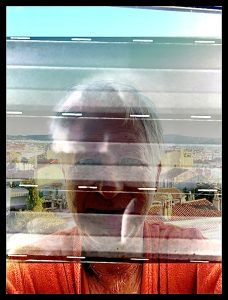
Ce sont mes vérités intimes que je peux créer, me permettant ainsi d’écrire mon propre roman narratif. Je photographie ou filme sans trucage et sans intelligence artificielle ; tout doit rester réel. Je photographie, je compose des albums documents, je performe en enregistrant la vidéo, et ensuite je monte un film de l’ensemble de ces éléments sur lequel je fais des captures d’écran… épaisseurs, profondeurs, couches et instantanés photographiques. J’avoue détester le plan parfait, souvent trop beau pour être « vrai ». J’apprécie l’évidence ; elle n’est jamais plus précieuse que lorsqu’elle est une surprise.
J’apprécie la profondeur, l’épaisseur et la complexité dans la réalisation de mes images : mon travail se compose de couches documentaires d’un même moment photographique. J’admire également la peinture classique et sa texture riche ; pour moi, la photographie constitue un instantané conceptuel moderne des multiples couches de la réalité. Ce n’est jamais l’évidence ou l’anecdote qui me guide, mais plutôt un miroir composé de ces multiples facettes, souvent immédiat et pourtant si construit par le regard, semblable à une révélation.
These are my intimate truths that I can create, allowing me to write my own narrative novel. I photograph or film without trickery or artificial intelligence; everything must remain real. I photograph, I compose documentary albums, I perform while recording the video, and then I edit a film of all these elements on which I take screenshots… thicknesses, depths, layers, and photographic snapshots. I confess to hating the perfect shot, often too good to be « true. » I appreciate the obvious; it is never more precious than when it is a surprise.
I value depth, thickness, and complexity in the creation of my images: my work is composed of documentary layers of a single photographic moment. I also admire classical painting and its rich texture; for me, photography constitutes a modern conceptual snapshot of the multiple layers of reality. It is never the obvious or the anecdote that guides me, but rather a mirror composed of these multiple facets, often immediate and yet so constructed by the gaze, similar to a revelation.
IDENTITE RECONNAISSANCE/IDENTITY RECOGNITION
Dans une société où l’individualisme réduit tout à des archétypes, la joie se trouve dans les moments où je parviens à développer ma propre identité, à l’ inventer, à me l’approprier. Il est alors d’autant plus précieux de la découvrir que de la chercher.
Tout cela pourrait sembler banal ou prétentieux s’il ne s’agissait avant tout d’une expérience vécue, ou si je ne m’engageais pas à la réaliser. Mon travail n’est ni grand ni petit, ni ceci ni cela, ni une différence, ni une catégorie ; il est avant tout une expérience multiple, contribuant à l’édifice de ce que je suis. Ni identité, ni sexe, ni genre, juste la mienne : une photographie romanesque, libérée et fraternelle, sans revendication ni besoin, sauf celui de nous rapprocher.
Sans doute parce que les catégories et nos stéréotypes médiatiques s’apprennent les uns des autres, ce n’est pas qu’elles élaborent l’être, mais qu’elles collaborent à l’être. Ce n’est pas tant une nouvelle image qu’une irruption d’une dimension nouvelle dans les mêmes images.
In a society where individualism reduces everything to archetypes, joy is found in the moments when I manage to develop my own identity, to invent it, to make it my own. It is then all the more precious to discover it than to seek it out.
All this might seem banal or pretentious if it weren’t primarily a lived experience, or if I weren’t committed to achieving it. My work is neither big nor small, neither this nor that, neither a difference nor a category; it is above all a multiple experience, contributing to the edifice of who I am. Neither identity, nor sex, nor gender, just mine: a romantic, liberated, and fraternal photography, without demands or needs, except that of bringing us closer together.
Perhaps because our media categories and stereotypes learn from each other, it is not that they elaborate being, but that they collaborate in being. It is not so much a new image as an irruption of a new dimension in the same images.
C’est une invitation à reprendre les photographies clichées, sur ces albums et ces réseaux de distraction, et sur les injonctions liées aux apparences. C’est un peu, et surtout, notre identité et notre histoire réappropriée, empreinte de gratitude. Merci à toutes ces rencontres qui m’ont façonné.
Pour moi, la joie est une expérience active de l’autre. Il me faut donc rassembler l’ensemble des expériences et des personnes qui ont contribué à créer non pas ce qui n’est plus ou ce qui a été, mais ce qui est. Derrière chacune de mes photographies se trouvent tous ceux qui m’ont donné vie ou m’ont façonné. Je ne peux reprendre une photographie, mais je peux tenter de la (re)créer en tant qu’expérience, ajoutant une documentation sur les êtres et les espaces qui l’ont fait naître. Ce ne sont pas des souvenirs, ni des gouffres ou des batailles ; je leur dois simplement d’être présent dans la photographie, et je leur dois beaucoup.
It’s an invitation to revisit clichéd photographs, those albums and networks of distraction, and the injunctions linked to appearances. It’s a little bit, and above all, our identity and our history reclaimed, imbued with gratitude. Thank you to all these encounters that have shaped me.
For me, joy is an active experience of the other. I must therefore bring together all the experiences and people who have contributed to creating not what is no longer or what was, but what is. Behind each of my photographs are all those who gave me life or shaped me. I cannot retake a photograph, but I can attempt to (re)create it as an experience, adding documentation of the people and spaces that gave birth to it. These are not memories, nor chasms or battles; I simply owe them the fact that I am present in the photograph, and I owe them a great deal.
didier cohas
contact : didier.cohas@me.com